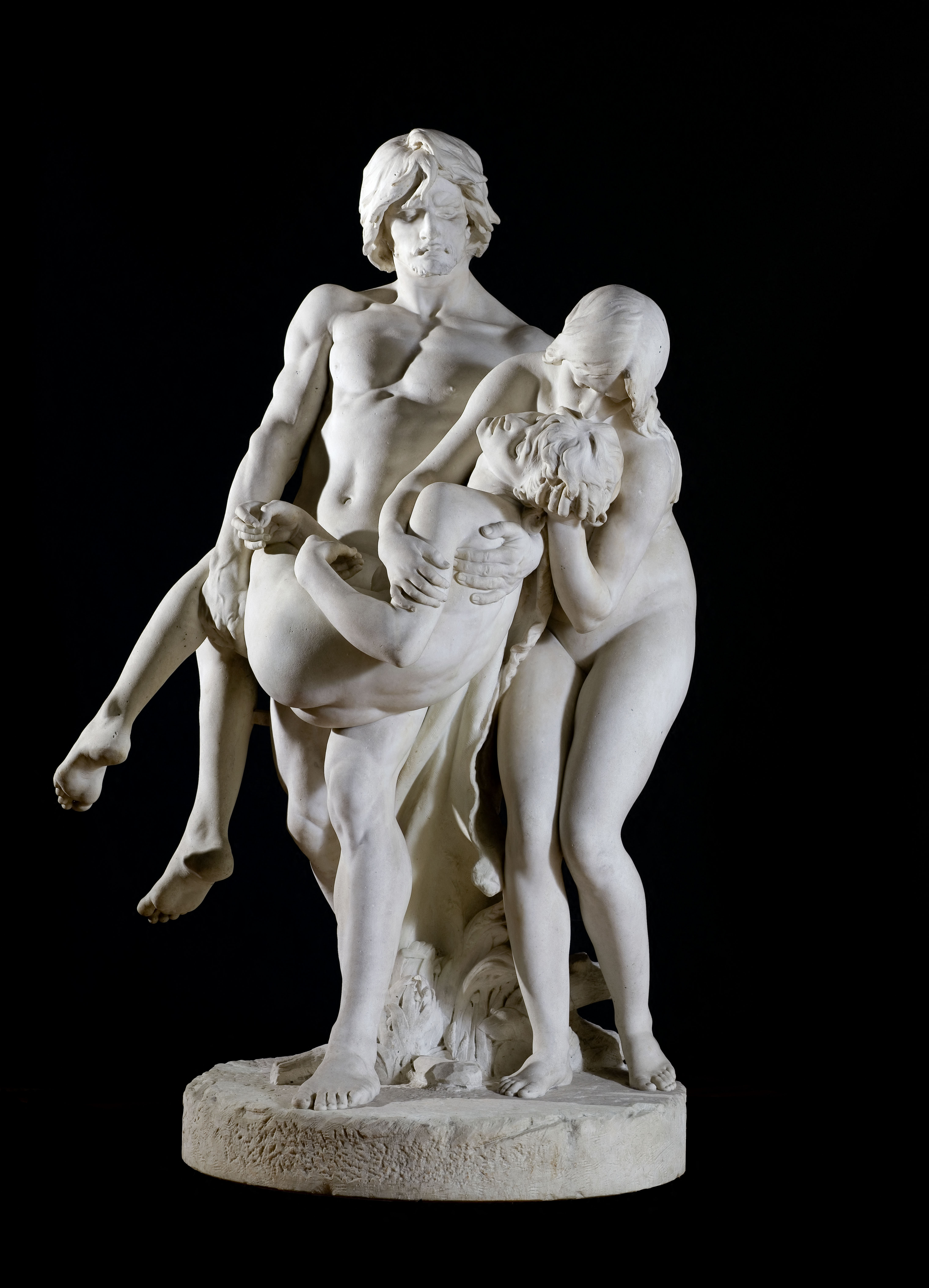
 Louis-Ernest Barrias, The First Funeral, 1883
Marble
This biblical group shows Adam and Eve carrying their son Abel, victim of his brother Cain's jealousy. The plaster sculpture won a Medal of Honour at the 1878 Salon, where it was considered as the "highest manifestation of the feeling that can be expressed in sculpture". Although displaying formal references to Michelangelo and Bernin, Barrias sets the mourning scene in a fantasy Prehistory evoked by a carved flint. Adam is given a wild-looking face with Gallic features, another allusion to the earliest days of humankind. In contrast, Eve and Abel's body are more reminiscent of Antiquity revisited by the Renaissance.
Acquisition after commissioning from the artist, 1878 - Inv. PPS7
 Louis-Ernest Barrias, El primer funeral, 1883
Mármol
Este grupo de inspiración bíblica escenifica a Adán y Eva llevando a su hijo Abel, víctima de la envidia de su hermano Caín. Galardonado con la medalla de honor en el Salón de 1878, se consideró entonces el modelo de yeso como «la mayor manifestación de los sentimientos que pueda expresar la escultura». Nutrido por referencias formales a Miguel Ángel o Bernini, Barrias sitúa sin embargo la escena de duelo en una Prehistoria de fantasía evocada por un sílex tallado. Adán está dotado de un rostro arisco con rasgos galos, otra alusión a los primeros tiempos de la Humanidad. Por contraste, los cuerpos de Eva y de Abel reivindican ser de modelos de la Antigüedad revisitados por el Renacimiento.
Compra por encargo al artista, 1878 - Inv. PPS7